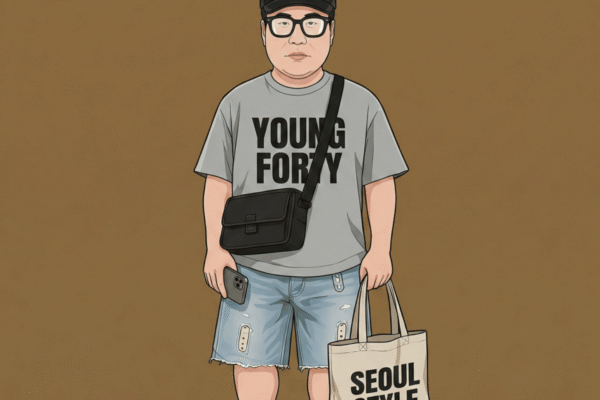

In Korean dramas or movies of the past, men in their 40s were often portrayed as typical “Ahjussi” (middle-aged uncles)—pot-bellied, wearing hiking gear as daily wear, and authoritative. However, in 2026, the 40-something Korean man has changed. They refuse to be defined by their age. We now call them the “Young Forty.”
Let’s dive into this unique generation that is currently the center of a hot debate in Korean society.
1. Who are the “Young Forty”?
As the name suggests, “Young Forty” refers to men in their 40s who live with a youthful mindset. They are primarily the Generation X born between the early 70s and early 80s.
The term was coined in November 2015 by trend analyst Kim Yong-sub in his book Life Trend 2016. He used it to describe men who refuse to age traditionally. As the median age of South Korea surpassed 40, the media quickly adopted this term, highlighting this generation—who spent their 20s during the cultural explosion of the 90s—as the new powerhouse of consumption.
Unlike the previous generation, they are sensitive to trends, invest heavily in their appearance, and have a strong desire to remain at the center of pop culture.
2. How Are They Different? (Characteristics)
They are the backbone of the Korean economy and the most powerful consumers. Here is what sets them apart:
- Fashion & Self-Care: They reject the “Ahjussi” style. Instead, they wear slim-fit suits, trendy sneakers, and niche perfumes. They are also active consumers of skincare treatments and grooming services (Barbershops).
- Cultural Pride: They experienced the “Renaissance of Korean Pop Culture” in the 90s. They were the first generation to lead internet culture and feel a sense of pride in being trendsetters. Even now, they listen to K-pop idols like NewJeans and rave about nostalgic content like Slam Dunk.
- The “iPhone” Indicator: Interestingly, while iPhone usage has dropped among Koreans in their 20s and 30s (the MZ generation), it has actually increased among men in their 40s. This symbolizes their desire to stay young and trendy.
- Mindset: They believe “age is just a number.” Instead of being an authoritarian boss, they want to be seen as a “cool older brother” (Oppa) who can communicate easily with younger colleagues.
3. The Controversy: “Cool” vs. “Cringe”
However, the term “Young Forty” has recently become a subject of ridicule and negative memes on the Korean internet. This is a fascinating glimpse into Korea’s generational conflict.
- Conflict with the MZ Generation: Young Forties believe they communicate well with the younger generation (20s-30s). However, younger employees often find them burdensome. For example, a boss forcing a “cool/casual team dinner” is seen as just another form of pressure.
- The “Fairness” & Economic Gap: This is the deepest issue. The 20s and 30s are currently struggling with unemployment and impossible housing prices. In contrast, the 40s lived through a period of economic growth, making it relatively easier to find jobs and buy homes.
- Political events and the asset gap have led the younger generation to view the 40s not as “cool seniors,” but as a “privileged class” (Vested rights).
- Big data analysis shows that over half of the online keywords associated with “Young Forty” are negative, such as “old,” “gross,” or “delusional.”
- Romance & “The Oppa Delusion”: When media glamorizes romance between 40-something men and 20-something women, the public often reacts with disgust, calling it a “fantasy” or “creepy.” Online communities frequently mock posts where older men misconstrue politeness from younger women as romantic interest.
4. Why Is This Happening?
The primary reason is that Korean society is aging rapidly. In the era of the “100-year lifespan,” being 40 is now considered an extension of youth. Additionally, with more people delaying or skipping marriage, there are more 40-somethings who invest in themselves rather than supporting a family.
Socially, they are a “Sandwich Generation”—caught between the traditional older generation and the hyper-individualistic younger generation. Their attempt to act young while holding economic power often looks like “trying too hard” to the eyes of the struggling youth.
Conclusion
The “Young Forty” controversy seems to be an extension of the deepening generational conflict and “hate culture” in Korea. The internet and anonymity have amplified small differences into massive hatred.
It is unfortunate that a specific age group is being mocked as a meme. It reflects a society where jealousy and hostility are easily expressed. The “Young Forty” phenomenon is complex—a mix of a desire for eternal youth and the harsh reality of socioeconomic gaps. Ultimately, I hope for a society where different generations can understand and respect each other, rather than mock one another.

![[K-History / True Crime] The Woman Who Knew Too Much: The Mystery of the Jeong In-suk Murder Case](https://allaboutk.com/wp-content/uploads/2026/01/jungin-suk-murder-600x400.png)
![[Military Story Part 2] Controversies and My Candid Thoughts on the Korean Military](https://allaboutk.com/wp-content/uploads/2026/01/Korea-military-part2-1-600x400.png)