
[The Harsh Winter of K-Cinema]
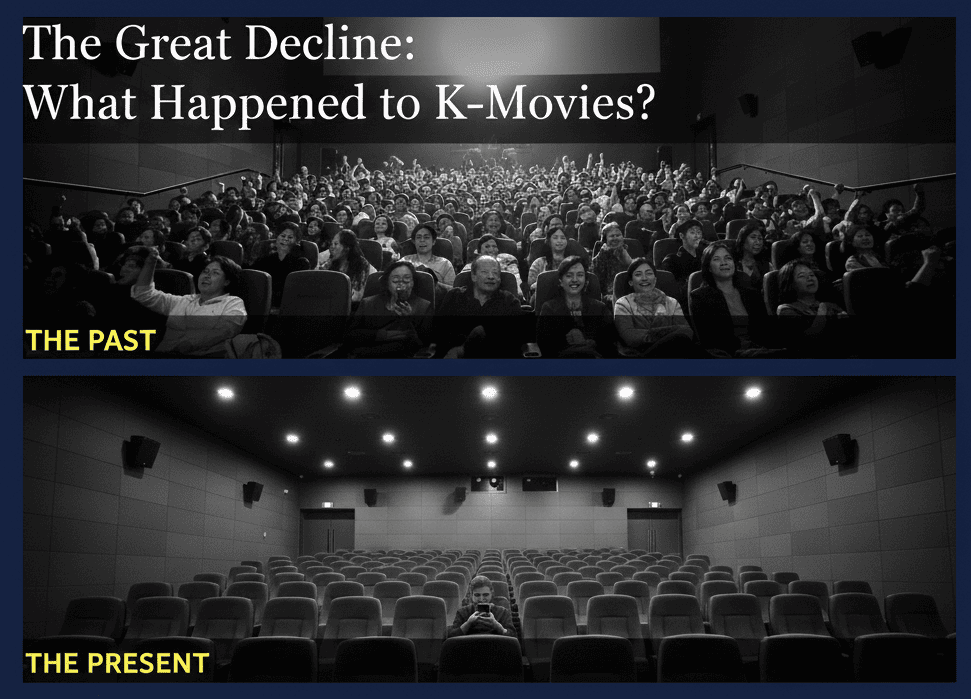
While K-pop and K-dramas continue to dominate the global stage in 2026, South Korean cinema is currently facing a harsh “winter.” Historically, Korea was the 5th largest film market in the world, with theaters packed to capacity. However, the industry has seen a dramatic decline recently. In 2019, the number of moviegoers peaked at 226 million, but by 2024, that number plummeted to 123 million—nearly a 50% drop. Therefore, we must ask: Why is the once-mighty K-movie industry struggling to survive?
1. Economic Factors: The End of “Affordable Leisure”
The Surge in Ticket Prices
In the past, going to the movies was the most cost-effective hobby for Koreans. In 2009, a ticket cost about 9,000 KRW, allowing a couple to enjoy a film and snacks for under 20,000 KRW. Because it was so affordable, students and adults alike could enjoy it as a routine hobby. Today, however, a single ticket costs 16,000 KRW, and for two people, the cost easily exceeds 30,000 KRW.
Furthermore, the number of theaters doubled from 300 in 2010 to 600 today. Unfortunately, the pandemic and the rise of OTT platforms caused theaters to lose their edge. Since the market is an oligopoly dominated by a few giants like CJ and Lotte, theaters easily justified hiking prices to cover their deficits. As a result, the high price has become a psychological barrier for consumers.
Economic Recession and Shifting Habits
Additionally, the overall South Korean economy has been sluggish since the pandemic. With youth unemployment rising and small businesses closing, households are prioritizing essential spending. Naturally, cultural spending is the first to be cut. Consequently, audiences now only visit theaters for “guaranteed hits.”
For instance, I used to watch a movie every month, but now I only visit the theater 3 to 4 times a year. Because the high price makes every choice feel like a risk, people are reluctant to pay over 10,000 KRW unless they are sure of the movie’s quality.
2. Social Factors: Shorts, OTT, and Changing Trends
The Rise of “Short-Form” Content
The dominance of YouTube Shorts and TikTok has changed media consumption. Specifically, people are becoming addicted to bite-sized content, which reduces their attention span for long-form films. Instead of spending two hours in a theater, many now watch “summary videos” or highlights. Therefore, the traditional cinematic experience is losing its appeal to the younger generation.
The Convenience of OTT Platforms
Moreover, the gap between theater release and OTT availability has narrowed significantly. Previously, you had to wait months to see a movie at home, but nowadays, you only need to wait a few weeks. Therefore, many viewers prefer the comfort of their own homes over a trip to the cinema.
3. The Path to Recovery: How to Save K-Movies
To revitalize the industry, structural changes are essential.
- Adjusting Actor Salaries: In Hollywood, lead salaries are about 15% of the budget, but in contrast, it’s 20-30% in Korea. By adopting a performance-based “running guarantee,” production costs can be lowered.
- Focusing on Quality: Films like Exhuma and The Roundup still drew over 10 million viewers because they were entertaining. This proves that people are still willing to pay if the content is worth the price.
In conclusion, the failure of 2025 was largely due to a lack of compelling content. If the industry can balance costs and focus on high-quality storytelling, South Korean cinema can return to its golden age.

![[K-History / True Crime] The Woman Who Knew Too Much: The Mystery of the Jeong In-suk Murder Case](https://allaboutk.com/wp-content/uploads/2026/01/jungin-suk-murder-600x400.png)

![[Military Story Part 2] Controversies and My Candid Thoughts on the Korean Military](https://allaboutk.com/wp-content/uploads/2026/01/Korea-military-part2-1-600x400.png)