
[Intro]
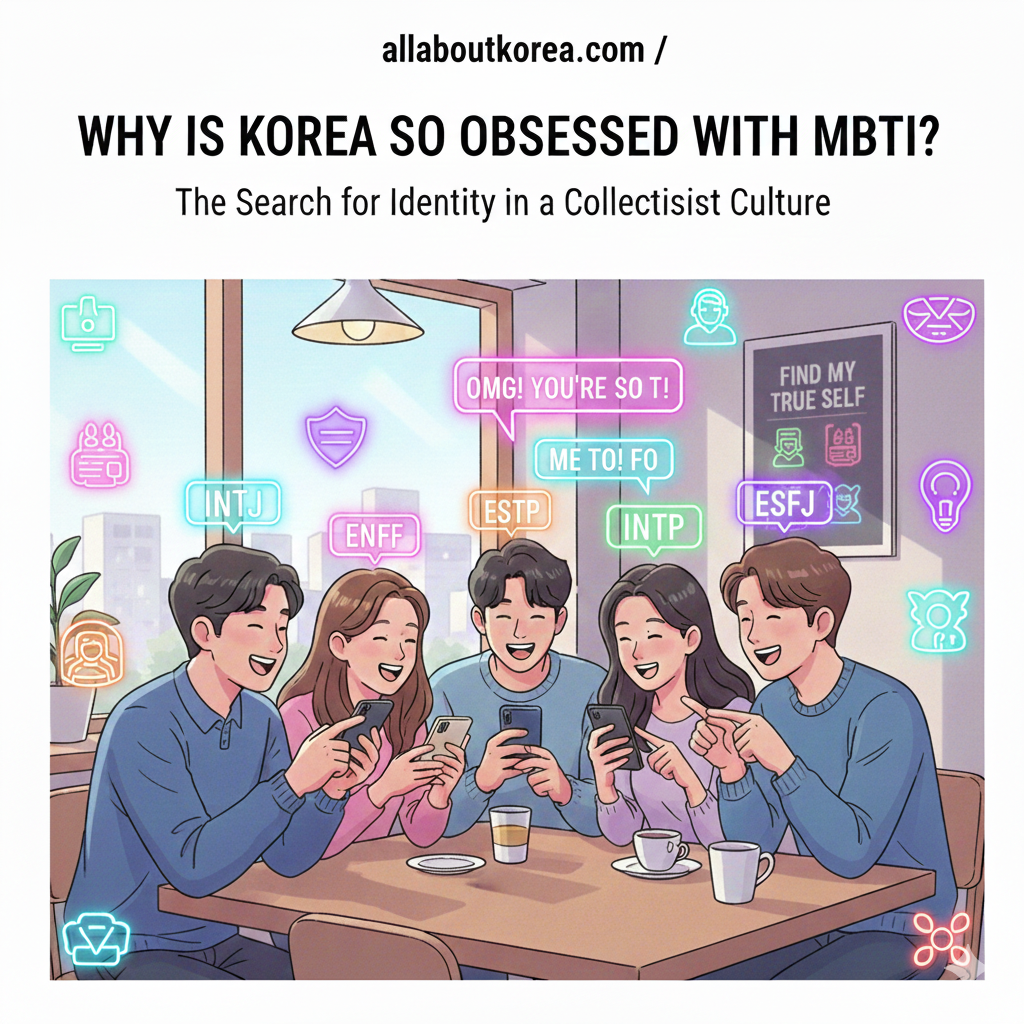
South Korea is currently in the middle of a massive MBTI craze. It has become such a standard icebreaker that the first thing people ask when meeting for the first time is, “What’s your MBTI?” Almost everyone in Korea knows their type. This popularity has sparked countless memes—for instance, if someone is being too objective or blunt, people jokingly ask, “Are you a ‘T’?” Why has this American personality test taken such a firm grip on Korean society?
1. The Meaning of MBTI
MBTI is a self-report personality indicator that classifies people into 16 types based on four criteria:
- Energy: Introversion (I) vs. Extraversion (E)
- Perception: Sensing (S) vs. Intuition (N)
- Judgment: Thinking (T) vs. Feeling (F)
- Lifestyle: Judging (J) vs. Perceiving (P)
Personally, I am an INFJ, known as the “Advocate.”
2. Before MBTI, There Were Blood Types
To understand this obsession, you have to know about the Blood Type craze that came before it. In the 90s and 2000s, Koreans categorized personalities by blood type. For example, Type A was considered “timid,” while Type AB was “eccentric.” It was a common question on blind dates, much like asking about zodiac signs in the West. While some just enjoyed it as a hobby, many believed it quite seriously. MBTI is essentially the successor to this trend.
3. How the Trend Exploded
While it’s hard to pinpoint exactly where it started, the craze truly took off during the COVID-19 pandemic. As people spent more time at home, these tests spread through social media. Once celebrities started sharing their results, it became a nationwide phenomenon.
4. The Cultural Reason: Collectivism and Identity
Why did it spread so effectively here?
- Collectivism: Korea is a highly homogeneous society with strong collectivist roots. You can see this in our company dinner culture (Hoesik) or social clubs.
- Confucian Influence: In our Confucian culture, the group often comes before the individual. Many children grow up following their parents’ predetermined paths rather than finding their own identity.
- Finding the “True Self”: I believe MBTI filled a deep void. In Korea, children often grow up following a strict “predetermined curriculum” and a way of thinking set by their parents. Because we spend so much of our lives meeting external expectations, many reach adulthood with a blurred sense of identity. Honestly, even for me, it hasn’t been long since I truly started reflecting on who I am. MBTI provided an instant answer. People read their results and feel a profound sense of relief: “Yes, this is exactly who I am!” It turned the difficult task of self-discovery into four simple letters that are easy to use when explaining ourselves to the world.
- The Irony: Interestingly, while it’s used for self-identity, meeting someone with the same type creates an immediate sense of belonging. We might be experiencing the “Barnum Effect“—mistaking vague, general statistics for our unique selves—but for many, it’s a way to feel connected in a society where we often feel lost.
5. The Good and the Bad
Every trend has its pros and cons. Collectivism helped Korea grow rapidly, and using MBTI as a light icebreaker to get to know someone is a positive thing. It makes conversations much easier.
However, over-immersion is a problem. Many people judge or limit others based solely on their four letters. For example, just because I’m an INFJ doesn’t mean I only stay at home. I actually enjoy a very active social life. We shouldn’t use MBTI to define or “trap” a person’s personality.
[Conclusion]
The MBTI trend in Korea seems to have moved beyond a fad and is becoming a part of the culture. It’s a great tool to get to know yourself and others lightly. Just remember: let’s use it as a conversation starter, not as a tool to judge or label others.
If you enjoy article try this one -> click

![[K-History / True Crime] The Woman Who Knew Too Much: The Mystery of the Jeong In-suk Murder Case](https://allaboutk.com/wp-content/uploads/2026/01/jungin-suk-murder-600x400.png)
![[Military Story Part 2] Controversies and My Candid Thoughts on the Korean Military](https://allaboutk.com/wp-content/uploads/2026/01/Korea-military-part2-1-600x400.png)