
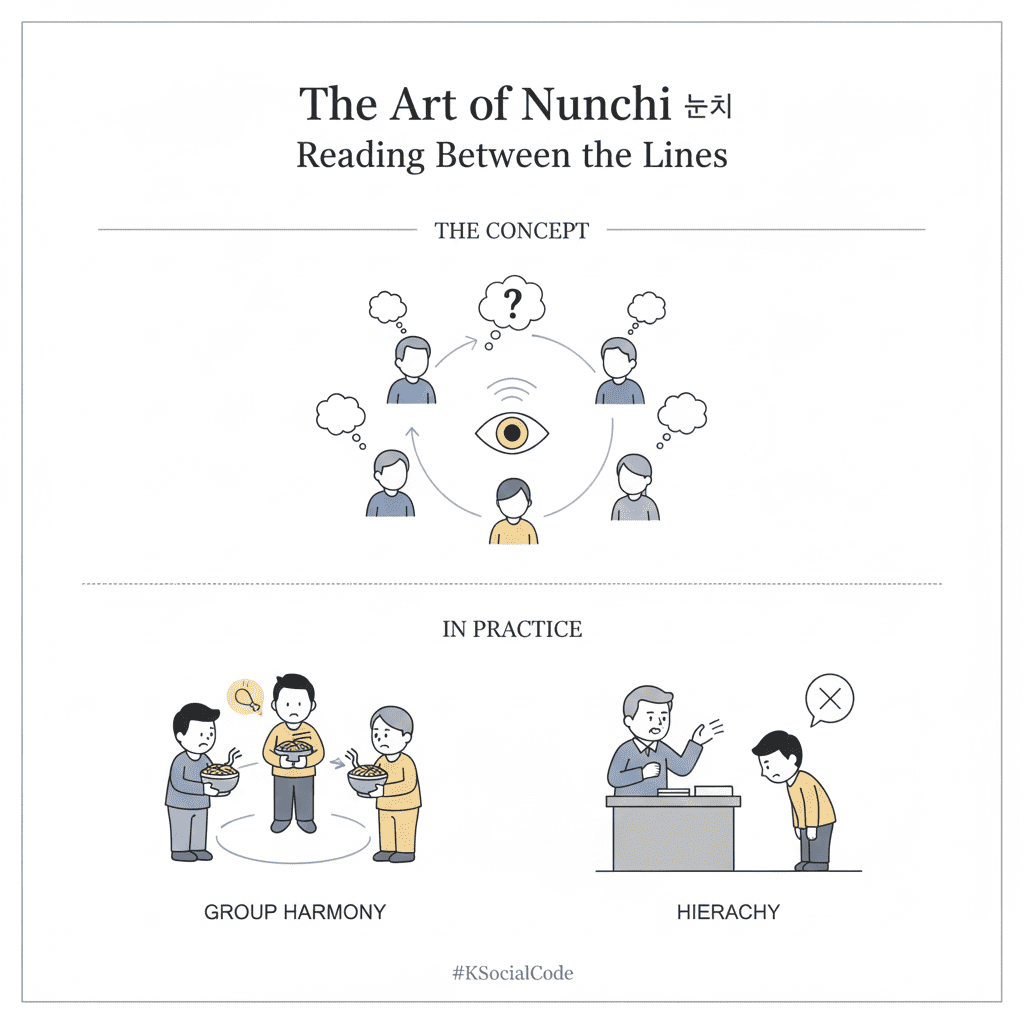
What exactly is “Nunchi” (눈치)? If you have ever spent time in South Korea, you have likely heard this term. In a dictionary, Nunchi is defined as “the ability to gauge another person’s feelings or a situation’s atmosphere.” However, in Korea, it is much more than that—it is an essential survival skill.
In Korea, being “Nunchi-less” (눈치 없는 사람) can lead to social exclusion. While every culture values politeness, the Korean concept of Nunchi is uniquely deep and complex. Today, I’ll share what Nunchi truly means through my own experiences and why it has become such a powerful social force.
1. Nunchi as a Survival Skill: Real-Life Examples
Growing up in Korea for 30 years, I’ve realized that Nunchi is the art of “acting appropriately for the situation.” It is a social radar that helps you navigate life smoothly.
- The Group Pressure: In middle school, our class had to practice a dance. Although I hated dancing, I couldn’t say no because I was mindful of the “Nunchi” of the popular kids who set the mood. Speaking up would have made me the “mood killer.”
- The Social Outcast: I had a friend in high school who was kind but had zero Nunchi. While everyone discussed football, he would abruptly talk about a random movie. When the class was being scolded by a teacher, he would daydream, causing the whole group to be punished even further. He lacked the ability to “read the room.”
- The Classroom Atmosphere: In university, a student kept asking repetitive questions even after the professor became visibly annoyed. Because that student lacked Nunchi, the lecture ended in an awkward atmosphere for everyone.
2. Why Does Korea Value Nunchi So Much?
Nunchi isn’t just about reading minds; it’s about not going against the group, understanding the emotions of superiors, and restraining your own opinions for harmony. There are four main reasons why this culture exists:
Collectivism (Group First)
Korea has a strong collectivist culture. If 8 out of 10 people want Jajangmyeon, the other 2 will follow suit, even if they crave fried chicken. Being cast out of a group feels like a “social death.” Interestingly, this starts at home; when a child makes a mistake and senses their parents’ anger, they begin to read the “mood” to avoid disrupting the family harmony again.
Clear Hierarchy
The hierarchy between superiors and subordinates is very distinct. If an older person wants to play soccer, you might give up your preference for basketball. In the workplace, failing to read your boss’s Nunchi can result in invisible disadvantages in your career.
The Korean Style of “Consideration” (Baeryeo)
Nunchi is often a form of kindness. For example, you don’t talk about romance movies in front of a friend who just went through a breakup. Even if someone says something factually wrong while excited, Koreans often don’t correct them immediately to avoid embarrassing them. This “public face-saving” is a key part of Nunchi.
Social Pressure and Labeling
Ultimately, the social atmosphere reinforces Nunchi. Society often labels those who lack it with stinging questions: “Why can’t you just figure it out on your own?” or “Can’t you read the room?” Because of this environment, Koreans naturally internalize Nunchi from a young age as a way to avoid being “stigmatized.”
3. Conclusion: A Survival Instinct for Harmony
As a Korean, I find it hard to give Nunchi a single definition. Ultimately, it is a survival instinct—bending your individual will to ensure the group’s stability and avoid social labeling.
To foreigners, this might seem stifling. You might ask, “Why should I do what others want instead of what I want?” I understand that perspective. However, in Korea, failing to observe Nunchi means failing to connect with society. It is our unique way of maintaining peace and building relationships.
In my next post, I will dive deeper into “Nunchi in the Workplace” and discuss the pros and cons of this culture in a professional setting. Stay tuned!

![[K-History / True Crime] The Woman Who Knew Too Much: The Mystery of the Jeong In-suk Murder Case](https://allaboutk.com/wp-content/uploads/2026/01/jungin-suk-murder-600x400.png)
![[Military Story Part 2] Controversies and My Candid Thoughts on the Korean Military](https://allaboutk.com/wp-content/uploads/2026/01/Korea-military-part2-1-600x400.png)
[…] [Note] For a deeper understanding of what Nunchi is and its cultural background, please refer to my previous post: [Link: The Art of Nunchi: The Secret Survival Skill in Korean Society] […]