
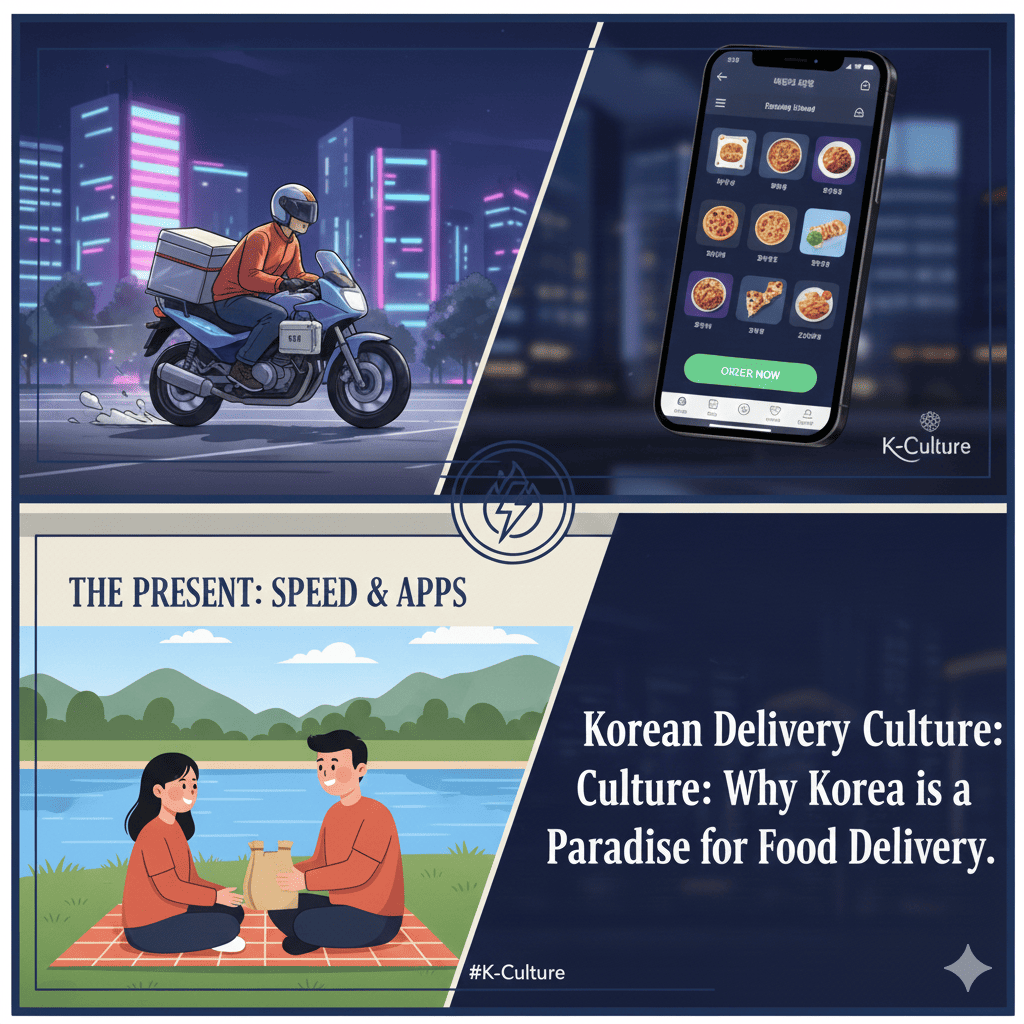
The term “Baedal-ui Minjok” (The Delivery Nation) was a nickname for Koreans long before it became a famous corporate name. Since the launch of delivery platforms, Korea’s food delivery culture has evolved rapidly. In this post, we will explore the history of Korean delivery and its unique characteristics today.
1. The History of Korean Food Delivery
The Origin: Joseon Dynasty (1392–1910)
Korean food delivery actually started during the Joseon Dynasty. The first recorded delivery food was Naengmyeon (cold buckwheat noodles). In 1768, a scholar named Hwang Yun-seok recorded that he ordered Naengmyeon for lunch with his colleagues. At that time, Naengmyeon was a popular delicacy among royalty and aristocrats. This marked the birth of the very first delivery services in Korea.
The Era of Chajangmyeon (1950s–1990s)
The modern delivery culture we know today began in the 1950s with Chinese restaurants. As telephones became common, ordering Chajangmyeon became a daily routine. During this era, delivery riders were full-time employees of the restaurants. They became famous for using “Chul-ga-bang” (silver metal delivery boxes) on motorcycles. Even without GPS, food usually arrived within 20 minutes of a phone call.
The Rise of Variety (2000s–Present)
In the 1990s, fried chicken and pizza became popular delivery items. By the 2000s, almost anything—including Jokbal (pig’s trotters) and Bossam (boiled pork)—could be delivered via a phone call. A famous phrase from this era is, “It just left!” Restaurant owners would often say this to calm hungry customers, even if the food hadn’t left yet.
2. Why is Delivery So Advanced in Korea?
There are three main reasons why Korea became a “Delivery Paradise”:
- Urban Infrastructure: Korea is a small country with high population density. Most people live in large apartment complexes. This makes it very easy for riders to find locations and deliver food quickly.
- The “Palli-Palli” (Hurry-Hurry) Culture: Koreans are known for their fast-paced lifestyle. If food doesn’t arrive within 20 to 30 minutes, customers often complain. This pressure forced the delivery system to become extremely efficient.
- “Customer is King” Mentality: In Korea, the consumer often has the upper hand. Delivery riders will even find you under a specific tree at the Han River park if you tell them your location. This extreme level of service is hard to find in other countries.
3. The Shift to Delivery Platforms and Fees
Since 2010, the culture has changed due to platforms like Baedal-ui Minjok. While these apps allow us to order virtually any food, they also introduced delivery fees.
For decades, delivery was considered a free service. Therefore, many Koreans still feel reluctant to pay delivery fees. If the food arrives cold or late after paying a fee, customers often leave harsh reviews. Even for me, as a Korean, paying for delivery still feels a bit wasteful, but the convenience is undeniable.
Conclusion: A Must-Try Experience in Korea
When I traveled abroad, the lack of fast delivery was one of the biggest inconveniences. If you are visiting South Korea, I highly recommend experiencing this culture. Ordering fried chicken at the Han River park is a unique scene you can only find here. Despite the debates over fees, Korea’s delivery culture remains something we are very proud of.
Read more article about Korea Culture -> Click

![[K-History / True Crime] The Woman Who Knew Too Much: The Mystery of the Jeong In-suk Murder Case](https://allaboutk.com/wp-content/uploads/2026/01/jungin-suk-murder-600x400.png)
![[Military Story Part 2] Controversies and My Candid Thoughts on the Korean Military](https://allaboutk.com/wp-content/uploads/2026/01/Korea-military-part2-1-600x400.png)
https://shorturl.fm/rgHmP