
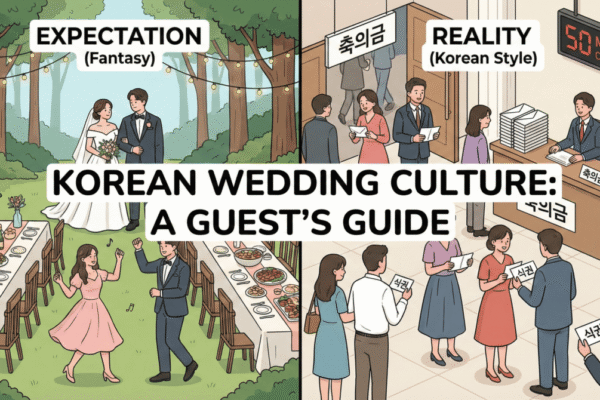
Korean wedding culture is vastly different from Western weddings. If you are imagining a scene from Twilight—an all-day party in a forest with dancing and drinking—you might be in for a surprise when you arrive at a Korean wedding hall.
In Korea, a wedding is less of a party and more of a “tightly scheduled 1-hour event.” From the perspective of a guest, here is everything you need to know about the unique, fast-paced, and efficient world of K-Weddings.
1. The “Factory-Style” Wedding: Done in 50 Minutes
Korean wedding venues often have multiple halls in one building, with ceremonies starting every hour. Because the next wedding starts immediately after the previous one ends, locals often jokingly call this a “Factory-style Wedding” (like an assembly line).
- The Sequence: Lighting candles (Mothers) → Groom enters → Bride enters → Vows → Congratulatory song/speech → Bow to parents → March out → Photos.
- Speed: This entire process usually takes about 30 to 50 minutes.
- The Bouquet Rule: Unlike in the West, where any single woman can catch the bouquet, in Korea, the catcher is pre-selected. A specific friend is designated to catch the bouquet in advance to ensure a perfect photo opportunity.
2. Before the Wedding: “Sudeume” and Invitation Meet-ups
The preparation starts with the “Holy Trinity” of Korean wedding prep, known as S-D-M (Sudeume):
- Studio (Pre-wedding photoshoot)
- Dress (Rental selection tour)
- Make-up (Professional salon service)
Once the date is set, the couple hosts “Cheong-첩-jang Moim” (Invitation Meet-ups). They treat their friends to a nice dinner while handing out physical invitations.
- Digital Dilemma: Recently, mobile invitations have become common. However, sending a mobile link to a friend you haven’t spoken to in years can cause social friction, as it may be interpreted as, “I’m just contacting you to collect cash gifts.”
3. Chuk-ui-geum: The Mandatory Cash Gift Culture
The most critical concept for a guest is Chuk-ui-geum (Congratulatory Money). When you arrive, the first thing you will see is a reception desk. There are white envelopes and pens ready for you. You write your name on the envelope, put cash inside, and hand it to the family members at the desk.
💰 How much should I pay? (2026 Standards) There are implicit rules based on your relationship and attendance:
- 50,000 KRW: If you are not attending the wedding (just sending money).
- 100,000 KRW: If you attend and eat at the buffet. (Since meal costs have risen, 50k is considered too little if you are eating).
- 100,000 KRW+: For close friends or colleagues, the amount goes up to 150k, 200k, or more.
- Why Cash? In Korea, weddings are often seen as a way for parents to “recover” the money they have given as gifts to other people’s weddings over the years. This is why even if you can’t go, it is polite to wire the money via banking apps.
4. Shik-gwon: The Meal Ticket
Once you hand over your cash envelope, you receive a “Shik-gwon” (Meal Ticket). This ticket is your pass to the banquet hall (usually a large buffet). Because the schedule is so tight, many guests simply hand in their money, get a ticket, and go straight to the buffet to eat without even watching the ceremony.
5. Guest Attire: The “No White” Rule
There is an unwritten dress code, especially for women.
- For Men: Suits or semi-formal attire (generally flexible).
- For Women: The standard is stricter. Since the bride is the star of the show, female guests should avoid wearing white to ensure they don’t outshine the bride.
- Safe Bet: Most guests wear beige, pastel tones, navy, or black suits/dresses.
Conclusion
You might hear news stories about Koreans hiring “Fake Guests” (part-timers) to make the wedding look crowded, fearing that a small wedding implies a lack of social connections. While this happens, it is an extreme case, not the norm.
Korean weddings might feel a bit transactional or business-like due to the cash culture and speed. However, the essence remains the same: two people promising a future together. Despite the hustle and bustle, the sincerity of blessing the couple’s future is always present.

![[K-History / True Crime] The Woman Who Knew Too Much: The Mystery of the Jeong In-suk Murder Case](https://allaboutk.com/wp-content/uploads/2026/01/jungin-suk-murder-600x400.png)
![[Military Story Part 2] Controversies and My Candid Thoughts on the Korean Military](https://allaboutk.com/wp-content/uploads/2026/01/Korea-military-part2-1-600x400.png)